
Recently, leading home furnishing enterprises such as Sophia, OPPEIN Home Group and Zbom Home Furnishing have successively released their third-quarter reports for 2025. Affected by factors including the fading of last year's subsidy dividends and the adjustment of the domestic real estate industry, the performance growth of most enterprises has stagnated, with significant pressure in the domestic market. Meanwhile, all these enterprises are accelerating their overseas expansion efforts, striving to open up a new growth trajectory, which has become a key focus in the current development of the industry.
01 Domestic Market Dilemma: Declining Performance and Shrinking Store Network Become Common Challenges
Since the beginning of this year, home furnishing enterprises in the domestic market have generally been trapped in the predicament of "simultaneous decline in revenue and profits along with a shrinking store scale". Their core businesses have been significantly impacted by the market environment, and the specific performance of the three enterprises is as follows:
OPPEIN Home Group: Comprehensive Weakening Performance and Significant Store Shrinkage
As a leading enterprise in the industry, OPPEIN Home Group's declining performance is quite representative. In the third quarter alone, the company achieved an operating income of 4.973 billion yuan, a year-on-year decrease of 6.10%. The cumulative operating income in the first three quarters reached 13.214 billion yuan, down 4.79% year-on-year. The profit side saw an even steeper decline: the net profit attributable to shareholders in the third quarter was 814 million yuan, a year-on-year drop of 21.79%, and the cumulative net profit attributable to shareholders in the first three quarters stood at 1.832 billion yuan, a year-on-year decrease of 9.77%. All core product segments witnessed a downward trend in revenue: the cabinet business generated 3.84 billion yuan in revenue, a year-on-year decrease of 4.8%; the revenue from wardrobe and supporting furniture products was 6.79 billion yuan, down 5.58% year-on-year. Concurrently, the store scale contracted. By the end of the third quarter of 2025, the total number of stores under all its brands stood at 7,480, a decrease of 333 compared with the end of 2024. Among them, the number of stores of the flagship OPPEIN brand decreased the most, by 361.
Sophia: Performance Pressure Amid Stock Market Transformation
Sophia also delivered a sluggish performance in the first three quarters. It recorded a cumulative operating income of 7.008 billion yuan, a year-on-year decrease of 8.46%; the net profit attributable to shareholders was 682 million yuan, down 26.05% year-on-year; and the non-recurring net profit attributable to shareholders was 720 million yuan, a year-on-year drop of 17.56%. During communication with investors, the company clearly stated that the performance decline is in line with the overall industry trend. The core reason lies in the changes in customer demand scale caused by the adjustment of the real estate industry. The domestic market has shifted from being "new housing-dominated" to "stock housing-dominated", and the customer group has gradually tilted towards those seeking housing improvement and secondary renovation. This shift in the market demand structure has exerted short-term pressure on the enterprise.
Zbom Home Furnishing: Sharpest Decline in Revenue and Profits with Comprehensive Business Contraction
Among the three enterprises, Zbom Home Furnishing witnessed the most prominent contraction. In the first three quarters, the company's cumulative operating income was 3.074 billion yuan, a year-on-year decrease of 16.36%, and the net profit attributable to shareholders was 173 million yuan, a year-on-year drop of 34.94%. All its segmented businesses experienced a downturn. The integrated cabinet business suffered the worst impact, with revenue falling to 1.056 billion yuan, a sharp year-on-year decrease of 36.47%. The customized wardrobe business generated 1.407 billion yuan in revenue, down 6.48% year-on-year, while other businesses achieved 222 million yuan in revenue, a year-on-year decrease of 17.42%. In terms of stores, the number of distribution stores for all product categories decreased. The number of integrated cabinet distribution stores dropped from 1,439 at the end of 2024 to 1,275 (a reduction of 164). The number of customized wardrobe distribution stores decreased to 1,399 (a reduction of 236). Additionally, the number of wooden door and wall panel stores, as well as direct-sale stores, decreased by 8 and 1 respectively.
02 Accelerated Overseas Layout: From "Exploration" to "Intensive Cultivation" Becoming a New Performance Pillar
Despite the pressure in the domestic market, securities firms generally hold an optimistic view on the potential of home furnishing enterprises' overseas layout, believing that this business will become an important pillar for future performance growth. Currently, the three enterprises have launched differentiated explorations in the overseas market, with initial results emerging.
Sophia: Focusing on Mid-to-High-End Markets and Steadily Advancing Globalization
Sophia's overseas business takes "prudent layout" as its core strategy. Southwest Securities assigned it a "Hold" rating in a research report, noting that "its profitability has recovered, operational efficiency has improved, and integrated home decoration and overseas layout have formed a dual pillar". Pacific Securities also gave it a "Buy" rating due to the expansion of its overseas business scale. According to the third-quarter report, Sophia now has 29 overseas distributors, with its business covering 32 countries and regions, and has completed 132 overseas engineering projects cumulatively. The company emphasizes that the overseas market is still in the basic layout stage. It will focus on mid-to-high-end projects and promote brand localization by opening exclusive stores. Meanwhile, it will improve its operational system in light of local consumption habits and market conditions, avoid blind expansion, and respect the development rhythm of overseas markets.
OPPEIN Home Group: Multi-Channel Breakthroughs and Surge in Overseas Orders
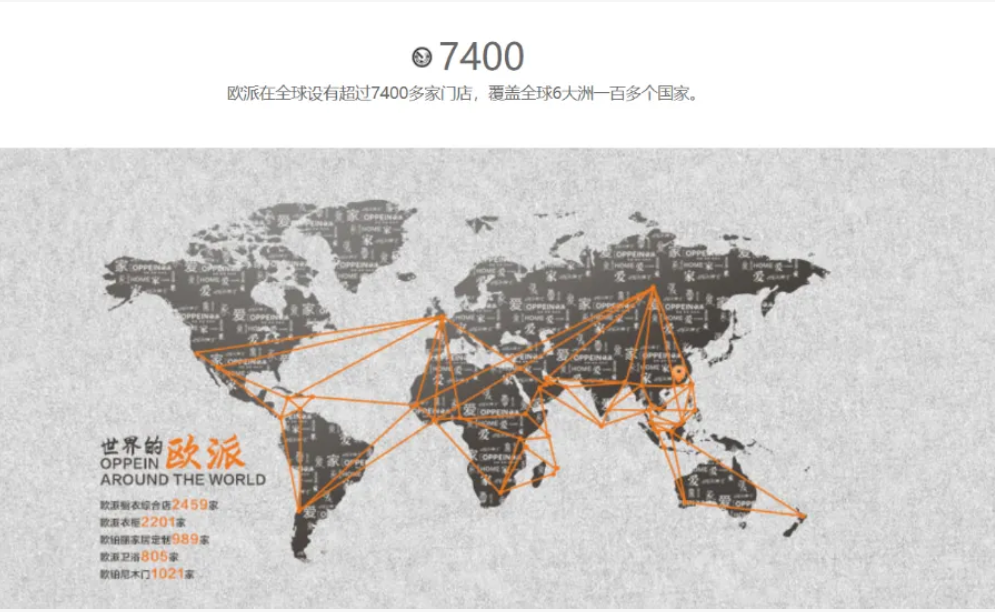
OPPEIN Home Group's overseas business has shown a momentum of "all-round breakthroughs". Tianfeng Securities mentioned in a research report that it "boasts remarkable advantages in multi-category and multi-channel layout, and overseas business has become a key highlight". At present, OPPEIN's sales network has covered 146 countries and regions worldwide. More importantly, the performance of its overseas engineering orders has increased by over 40% year-on-year, serving as a crucial supplement to alleviate the pressure on its domestic business and demonstrating its strong channel and product competitiveness in overseas markets. Industry sources revealed that OPPEIN conducted intensive research and investigations on the Malaysian and Southeast Asian markets in 2024 and has identified Southeast Asia as one of its new growth engines.
Zbom Home Furnishing: Leading Growth Rate with Overseas Business as a "New Engine"
Zbom Home Furnishing's overseas business has achieved the most rapid growth and has become a veritable "new engine" for the company's development. The third-quarter report shows that during the reporting period, its overseas business achieved an operating income of 217 million yuan, a substantial year-on-year increase of 65%, and its gross profit margin rose by 0.77 percentage points compared with the same period last year, realizing both profit and scale growth. Up to now, Zbom Home Furnishing's business has spread across 41 countries and regions, with 36 distribution stores opened. In the first half of 2025 alone, it newly signed 7 overseas distributors, marking a significantly accelerated pace of overseas expansion and laying a solid foundation for subsequent growth.
03 Challenges and Prospects of Overseas Exploration
It is worth noting that the overseas market is not a smooth path. An insider from a customized furniture distribution company analyzed that mature brands already occupy stable market shares in various overseas markets. For domestic brands to expand overseas, they need to overcome multiple obstacles. They must not only ensure the stability of the supply chain to avoid delivery delays caused by logistics and production capacity issues but also abandon the inertial thinking of "price competition". Only by impressing consumers with high quality, exquisite design and quality services can they truly establish brand recognition.
Judging from the current layout, the overseas exploration of home furnishing enterprises is still in its initial stage. Whether they can create a new growth curve through core competitiveness such as services and operations in the future depends not only on short-term orders and scale but also on their long-term ability to adapt to the consumption demands of overseas markets and accumulate brand value. For the home furnishing industry which is in a period of transformation, the overseas market presents both challenges and a key direction to unlock new growth space.