
Against the backdrop of slowing global economic growth, the commercial office market in St. Petersburg is presenting a unique pattern of growing supply and stable yet evolving demand. According to Kunity’s latest Q3 2025 market data, the office market of this Northern Capital has seen key new developments in new supply, rental trends, and regional differentiation. In particular, as Chinese enterprises accelerate their presence in St. Petersburg’s industrial manufacturing, automotive, energy, and digital economy sectors, office demand has taken on new features of industry‑binding and region‑focused expansion.
Today, Kunity provides exclusive market insights and strategic advice for Chinese enterprises in St. Petersburg, Russia.

01 Market Overview: Supply Expands Against the Trend, Demand Returns to Rational Balance
1. The most prominent feature of St. Petersburg’s office market in 2025 is the sharp increase in new supply. A total of 104,000 sqm of new office space was added in the first three quarters, double the volume in the same period of 2024. This growth is driven by both stronger developer replenishment activity and the low-base effect of 2024. Full-year new supply is projected to reach 156,000 sqm.
2. As of the end of Q3, the total stock of Grade A and Grade B high-quality office space reached 4.856 million sqm and is forecast to exceed 4.9 million sqm for the full year, with market scale continuing to expand. On the demand side, activity has returned to a rational level: transaction volume totalled 155,000 sqm in the first three quarters, remaining moderate but nearly halved compared with the high level of the same period in 2024, reflecting a slower pace of corporate expansion.
3. Notably, the market has not seen significant inventory accumulation. On the one hand, high-quality space in core areas remains scarce; on the other hand, 78% of new supply has been pre-leased or pre-sold, with only 350,000 sqm entering the open market. The supply‑demand relationship remains relatively balanced, providing a favourable environment for Chinese enterprises to choose locations and arrange flexible layouts according to their needs.
02 Core Data Analysis: Significant Rental Differentiation, Moderate Vacancy Rate Fluctuations
1. Rental Trend: Grade B Offices Become the “Dark Horse”
In Q3 2025, St. Petersburg office rents showed a clear split: stable high end, rising mid‑end.
Grade A high-end offices:
Average rent: 2,862 rubles/sqm/month (approx. RMB 262), including VAT and operating costs, excluding property management fees.
A year-on-year increase of less than 1%, significantly slower than in 2024, with mild adjustments in some non-core locations.
Grade B mid-range offices:
Average rent: 1,916 rubles/sqm/month (approx. RMB 175), surging 17% year-on-year — far outpacing Grade A and exceeding the full-year 2024 level, becoming the main growth driver.
This trend reflects strong demand from SMEs for cost-effective office space and upgrades in facilities and construction quality for Grade B buildings. Newer projects also command higher rents:
New Grade A offices: 27% higher than pre-2022 buildings
New Grade B offices: 8% higher than older stock
2. Vacancy Rate: Moderate Overall Rise, Sharp Regional Differences
As of end-Q3, the overall office vacancy rate stood at 5.0%, up 1.4 percentage points year-on-year, mainly due to concentrated new Grade B supply.
Grade A vacancy: 5.3%, up 2.0 pp — still within a reasonable range
Grade B vacancy: 4.9%, up 1.2 pp, concentrated in non-core areas
Large vacant units are particularly scarce: spaces above 1,000 sqm account for less than 11% of available options. Chinese enterprises setting up regional headquarters or R&D teams (e.g., Huawei’s St. Petersburg R&D centre, automotive component regional offices) are advised to secure space in advance. By the end of 2025, the overall vacancy rate is expected to drop to 4.4% as pre-leased space is formalised.
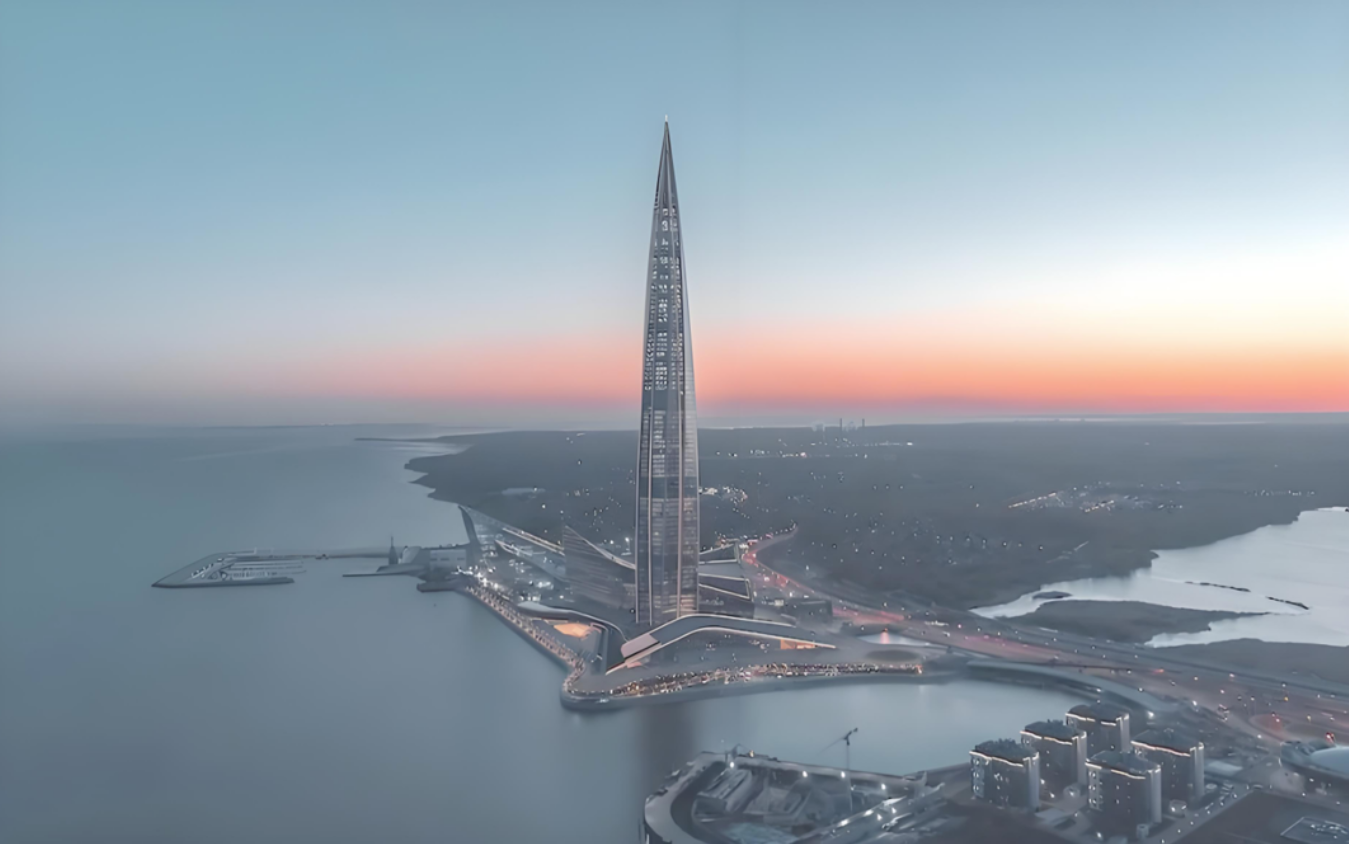
03 Regions & Demand: Core Areas Remain Strong, Three Industries Lead the Market
1. Regional Differentiation: Core Areas in Short Supply, Competition Intensifies in Non-Core ZonesRegional divergence has grown, forming a clear gradient highly aligned with Chinese enterprises’ industrial layout:
Central District:
Grade A rent: 3,646 rubles/sqm/month (approx. RMB 333) — citywide high.Vacancy rate: only 3.6%.Ideal for Chinese financial institutions (e.g., Bank of China St. Petersburg Branch) and cross-border e-commerce regional headquarters (AliExpress, Temu).
Petrogradsky District:
Grade A vacancy: 0.3%.Rent: 2,770 rubles/sqm/month (approx. RMB 253).Home to technical universities including SPbPU; preferred by tech firms such as Huawei and ZTE for joint R&D.
Moskovsky District:
Grade A vacancy: 16.3%.Rent: 2,606 rubles/sqm/month (approx. RMB 238).Strong cost-performance, adjacent to automotive clusters (Geely, Great Wall Motors partners).Suitable for Chinese auto parts and machinery manufacturers.
Vasilievsky Island & Naberezhnye District:
Balanced supply and demand, mid-range rents.Near key Chinese-developed projects (e.g., Hongfu New City) and logistics hubs.Popular among SMEs in cross-border logistics and agricultural processing.
2. Demand Structure: Finance, IT, Construction Lead; Chinese Enterprises Drive Growth
Three industries account for over 50% of 2025 office transactions, with Chinese enterprises as major incremental contributors:
Finance (20%): Chinese banks and insurers show stable demand for Grade A space in core areas, prioritising location brand and cross-border settlement convenience.
IT (17%): Chinese tech firms including Huawei and ByteDance are among the fastest-growing tenants, favouring well-equipped Grade B offices with room for R&D expansion.
Construction & Real Estate (14%): MCC, CSCEC and others involved in Hongfu New City, China‑Russia Exhibition Centre projects drive demand aligned with new supply, focusing on industrial chain collaboration.
Leasing remains dominant at 88% of transactions, while whole-building sales account for only 12%, showing Chinese enterprises prefer a light-asset leasing + flexible expansion model.

04 New Market Dynamics: High-End New Projects, Clear Future Trends
New projects in 2025 feature upgrading quality and high pre-lease rates, closely linked to Chinese industrial investment:
Atlas City II (96,000 sqm, Grade A), near Moskovskie Vorota metro, has attracted multiple Chinese auto parts suppliers due to proximity to automotive and logistics clusters.
Greenhouse (25,000 sqm, Grade B) in the northern non-core zone shows an 80% vacancy rate, warning of risks in non-industrial areas.
Over 70% of annual new supply is concentrated in core districts, dominated by Grade A projects such as:
Severnaya Palmira (478,000 sqm, Grade A)
Nevskaya Ratusha III‑9 (189,000 sqm, Grade A)
Looking ahead to 2026:
1. Russia’s key interest rate is expected to fall from 18.8–19.6% (2025) to 12.0–13.0%, significantly reducing financing costs for Chinese enterprises, especially in automotive, new energy, and digital economy.
2. More than 10 projects are under construction, including Orimi Centre (300,000 sqm, Grade B) and Smart Svetlanovsky (59,000 sqm, Grade A). Some have initial cooperation with China‑Russia industrial clusters (e.g., Shushary SEZ electronics firms) to prioritise Chinese tenants.

05 Kunity Insights & Recommendations: Anchor Industrial Synergy, Target Core Value Zones
1. Corporate Site Selection: Match Region to Industry, Balance Cost & Resources
Tech & R&D (Huawei, ZTE):
Prioritise Grade A in Petrogradsky & Central Districts, near universities and digital infrastructure.
Secure spaces above 1,000 sqm via pre-lease; consider joint labs with local universities.
Automotive & Components (Geely, BYD suppliers):
Focus on new Grade B in Moskovsky & Vasilievsky Island.
Rents ~30% lower than Grade A; moderate vacancy supports flexible expansion.
Cross-border Trade & Logistics (JD Logistics, COFCO):
Choose Naberezhnye District and Hongfu New City vicinity.
Close to Finnish Gulf ports and China‑Russia logistics corridors; rents 1,900–2,300 rubles/sqm/month (approx. RMB 174–210).
Finance & Headquarters (Chinese banks, regional HQs):
Select Grade A in Central District (e.g., Nevskaya Ratusha series).
Concentrated business resources, strong branding, near the Central Bank’s St. Petersburg branch for cross-border settlement.
2. Investor Strategy: Align with Chinese Industrial Clusters, Balance Risk & Return
Conservative investors (state‑owned platforms):
Focus on Grade A in Central & Petrogradsky Districts (vacancy as low as 3.6%), with stable long-term income from quality tenants including Huawei and Chinese banks.
Target office space near China‑Russia key projects for industrial synergy benefits.
Aggressive investors (private institutions):
Focus on industry‑bound Grade B projects near Shushary SEZ and Moskovsky automotive clusters.
Rents rising 17% YoY; strong appreciation potential with Chinese electronics and automotive tenants.
Example: Smart Svetlanovsky, with dedicated R&D space for Chinese tech firms.
Risk control:
Prefer projects with Chinese tenant pre-leasing (78% of 2025 new supply pre-committed).
Avoid remote non-core Grade B projects, which may face vacancy periods exceeding six months and limited demand from Chinese enterprises.
Kunity believes St. Petersburg is becoming a core hub for Chinese enterprises to deepen their presence in Russia and reach the CIS. The office market is not only a space carrier but also a critical node for industrial collaboration and resource connectivity.
By leveraging their industrial strengths and aligning with regional and rental dynamics, Chinese enterprises can achieve dual success in office location and business expansion, seizing early opportunities in this transitional market phase.